Is Advice and Guidance Safe?
August 20, 2026


Every day in Gloucestershire, GPs and paramedics face the same decision: this patient needs specialist input now. Where do they go?
Before Cinapsis, the practical answer for most was the emergency department. Not because every patient needed emergency care, but because emergency departments are always open and always able to escalate. They were the path of least resistance when a clinician needed specialist input quickly.
The Gloucestershire pathway was built on a different premise: if a GP or paramedic can reach an acute physician directly in real time, before the patient moves, the clinical decision can be made at the point of referral rather than at the end of a journey through A&E.
Putting specialist advice before patient movement rather than after it, is what the data now reflects.
The platform has handled 236,902 cases since go-live in January 2019.
In 2025/26 alone, 22,231 acute medicine cases were managed through the pathway, up from 14,137 in 2022/23. All 63 GP practices in Gloucestershire use the platform. 78 referring organisations are now connected, including ambulance services, whose share of activity has grown from 15% of all cases in 2022/23 to 26.1% in 2025/26.
The platform runs outside office hours too. 15% of cases in 2025/26 came in outside the 08:00 to 18:00 window — compared with 11.9% in 2022/23 — reflecting growing reliance on the pathway at times when alternatives are most limited.
The median time to reach an acute physician through the platform is 25 seconds.
That figure has remained consistent across four years (29 seconds in 2022/23, 25 seconds in 2025/26) even though volume has grown . Referrer satisfaction has been rated at 4.8 out of 5 in every year since 2022/23.
In 2025/26, 93.5% of acute medicine cases with a documented destination were managed without an ED attendance — up from 80.6% in 2022/23.
The fall in GP referrals sent to ED is particularly notable. In 2022/23, 17.6% of GP referrals resulted in the patient being directed to an emergency department. In 2025/26, that figure is 2.3%.
For ambulance referrals, the ED share has fallen from 29.5% to 13.2% over the same period.

The fall in ED share is not explained by a fall in GP referral volume. GP referral volume has been broadly flat across the four years (10,852 to 11,690 cases), matched by practice code to the ICB's list of 63 Gloucestershire practices.
Before 2024/25, the pathway showed the seasonal pattern typical of urgent care: a higher share of cases directed to ED in winter than in the rest of the year. From 2024/25, that gap has closed.
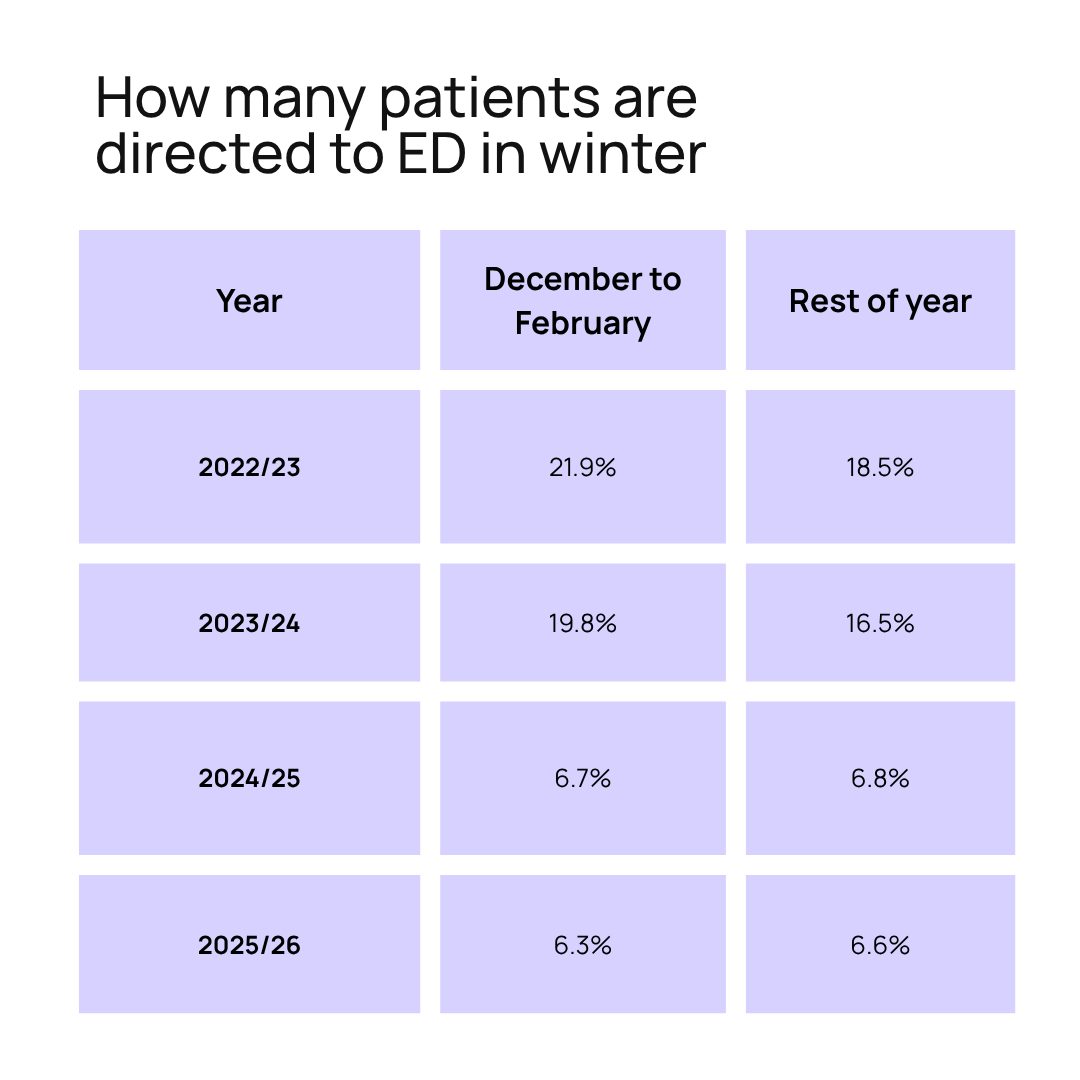
In 2025/26, the winter ED share was 6.3% — statistically indistinguishable from the 6.6% in the rest of the year. The pathway is providing consistent performance across seasons at a volume that would previously have created material winter pressure.
The stroke pathway tells a similar story. In 2022/23, 26% of stroke cases with a documented destination were directed to an emergency department. In 2025/26, that figure is 4.7%.
From 2024/25, direct admission to the hyper-acute stroke unit (HASU) or CT became available through the platform, with 291 cases taking that route in 2025/26. A new Stroke Same-Day Emergency Care unit (Hatherley Ward) opened a separate direct admission pathway in the same year: it handled 141 cases in 2024/25, rising to 291 in 2025/26.
The cumulative effect: a pathway that in 2022/23 sent more than one in four stroke cases to ED now sends fewer than one in twenty.
In 2025/26, 14,267 ED attendances were avoided through the pathway. At a national tariff of £172 per attendance (the lowest tariff involving any investigation), the avoided cost is £2.45 million.
In addition, trust modelling of the 2,396 patients managed in primary or community care in 2025/26 estimates that 580 hospital admissions were avoided. The methodology: a 24% admission rate had those patients attended ED, a 9-day average length of stay, and an NHS bed day cost of £562 (The King's Fund, July 2026). That generates 5,102 bed days released — equivalent to 14 beds occupied every day of the year.
Valued at £562 per bed day, that is £2.87 million in released inpatient capacity.
Total avoided cost and released capacity in 2025/26: £5.32 million.
Gloucestershire Hospitals NHS Foundation Trust has completed its own analysis of mortality outcomes by admission route, covering August 2023 to June 2025, adjusted for age, sex, admission route, diagnosis and co-morbidities.
As the pathway has matured, the Gloucestershire team has tracked a measure that sits behind the attendances and bed days: the number of patients whose lives are estimated to have been saved through earlier specialist intervention and faster routing to the right care.
The trust's summary: "Clear mortality benefit for patients who are admitted directly to AMU/MAZ: 1 life saved per day."
In the pathway’s earlier years that figure stood at approximately one patient per day. Over the last 12 months it has risen to two patients per day. In the last six months the estimate has reached four patients per day.
Of the admission routes analysed, only the ED-to-inpatient route — where patients bypass specialty review — sits above expected mortality. Every route involving direct specialist review before admission sits at or below expected mortality.
The finding points to something that has been suspected clinically for some time but is rarely demonstrated at this scale with this level of adjustment: that the route into hospital, not just whether a patient is admitted, affects the most critical of clinical outcomes and confirms that direct admissions with Cinapsis saves hundreds of lives every year.
Sarah Walters, Associate Director of Urgent Care and Flow Transformation at NHS Gloucestershire ICB:
"We are extremely pleased with this data which reflects what we already knew. Our teams manage incoming calls from GPs and paramedics very efficiently. This results in the vast majority of patients being admitted directly to hospital units such as SDEC and AMU which reduced the number of contact points and enables patients to be managed more efficiently."
Emma Wylie, Clinical Lead:
"Cinapsis enables us to turn Emergency Care into Planned Urgent Care, setting up the beginning of the patient journey for a whole range of acute medical conditions before they even arrive at the hospital."
In 2025/26, Gloucestershire Hospitals NHS Foundation Trust managed 22,231 acute medicine cases through a county-wide specialist access pathway built on Cinapsis. The results across that year:
£5.32 million saved, comprising £2.45 million in avoided ED attendances and £2.87 million in bed days freed.
14 beds released every day of the year, as patients directed away from ED and into same-day units or community care freed inpatient capacity that would otherwise have been occupied.
4 lives saved every day (estimated by the trust’s own mortality analysis, adjusted for age, sex, diagnosis and co-morbidities. In the pathway’s early years that figure stood at one patient per day). Over the last 12 months it rose to two. In the last six months the estimate has reached four. Of all admission routes analysed, only the ED-to-inpatient route sits above expected mortality.
4.8 out of 5 referrer satisfaction, consistent across every year since 2022/23, at a volume that has grown by 57% in three years.
Figures are drawn from Cinapsis platform data for Gloucestershire-commissioned activity, September 2022 to August 2026, plus an all-cases summary export for earlier years. Bed days and the mortality analysis are the trust's own.
Discover more about Cinapsis and how it transforms NHS pathways.


